Two weeks ago I was on the phone with a Big 4 partner who had just been moved from equity to salaried. Twenty-two years at the firm.
The line he kept repeating was: "I'm not sure what they hired me to be anymore."
He is not the only one. The FT has been reporting partner demotions at KPMG and EY for months. That is not a one-off restructuring move. That is the economics breaking.
I place partners and directors into strategy consulting across EMEIA. Over the last six months the conversations I am having on both sides of the table have changed faster than at any point in my career. Firms are restructuring their partnerships. Partners are restructuring their careers. Clients are restructuring what they will pay for. And every one of those movements is connected.
The Big Four partnership pyramid has been the most reliable career structure in professional services for forty years. Hire juniors in massive cohorts. Promote a few to partner. The few who make it through win the equity prize, the profit share, the job-for-life.
That model is no longer stable. The leverage economics underneath it are being dismantled in public. The question is no longer whether the pyramid cracks. It is what replaces it.
Squeezed From Both Ends
This is not single-cause. The leverage structure is being squeezed simultaneously from the top and the bottom, and the maths only works one way.
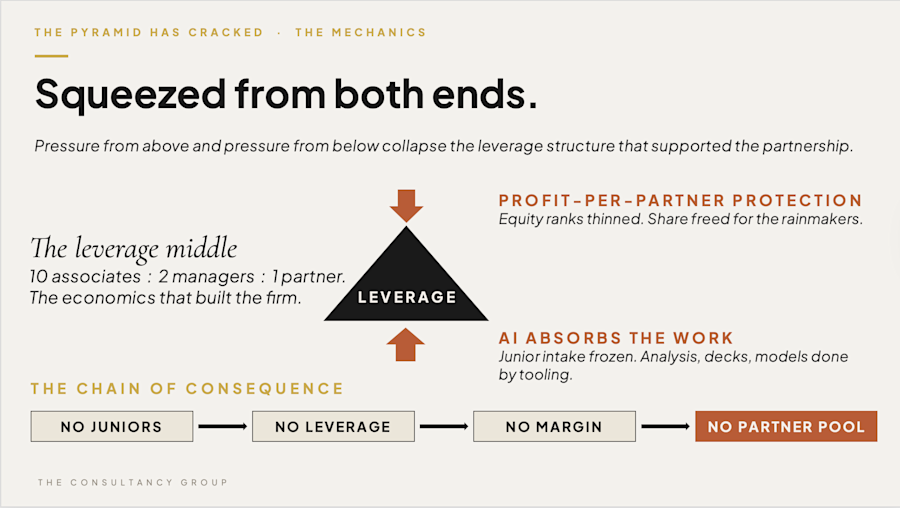
At the top, firms are protecting "profit per partner" by thinning the equity ranks. KPMG and EY have been the most visible movers, but the pattern is wider than that. The partners being moved to salaried roles are not poor performers being managed out. They are partners who, by the maths of the firm, do not generate enough fee revenue to justify the equity allocation. The share is being freed up for the rainmakers.
At the bottom, junior intake is frozen. Some of this is the market. Consulting fees have softened and headcount has followed. But more of it is structural. AI is eating the work the bottom of the pyramid used to do: the analysis, the deck building, the model running, the synthesis of the first draft. Partners I speak to are openly questioning whether they need the next cohort of analysts at all.
The chain of consequence is mechanical.
No juniors, no leverage. No leverage, no margin expansion. No margin expansion, no justification for a large partner pool.
The "Manager of Managers" partner model becomes obsolete because the maths underneath it can no longer be made to add up. This is what is collapsing. Not the firms. The economic structure that built them.
What the AI Numbers Are Actually Telling You
The headline numbers from the major firms are no longer marketing. They are restructuring in different language.
BCG closed 2025 at $14.4bn revenue with 33,500 staff. 25% of that revenue now comes from AI work. That is not a service line. That is a quarter of the firm's commercial output, delivered by a workforce being rebuilt around the technology.
The same pattern runs across the others. Deloitte, PwC, EY, KPMG, McKinsey and Bain are all publicly committing nine and ten-figure investments into proprietary AI platforms, and all of them are hiring engineers, data scientists and platform architects faster than they are hiring consultants. The technical centre of gravity has shifted inside the firms.
What this does to the leverage economics is mechanical. A traditional engagement is priced on team size and hours: ten associates supporting two managers supporting a partner. The partner's economics rely on the leverage of the team underneath them. When the team gets smaller because the technology absorbs the work, the leverage goes with it. When the leverage goes, so does the justification for the partner pool that was built to manage it.
This is what BCG means when it says clients want "build-with" rather than "slide-ware." It sounds like a positioning point. It is a leverage point. Build-with engagements use fewer people and more technology. They reduce team size and increase technical intensity at the same time. The output is more valuable. The economics that supported the old partnership are not.
The Pricing Reset
I had a conversation last month with an ex-MBB Operating Partner now at a mid-cap PE fund. He sees the consulting market from both sides. He pitched it for fifteen years. Now he buys it.
His read: "Clients no longer believe the old maths."
This matters more than the AI investment numbers, because it is buyer-led. The firms are not transforming themselves out of choice. They are being transformed by what their clients will pay for.
Specifically, the fee model that priced engagements off team size and time is being openly challenged. Procurement is asking for "AI efficiency savings" of 20 to 30% before a project even launches. That number is not theoretical. It is the assumed labour cost that AI now absorbs. If the consulting firm does not surface those savings, the client surfaces them in the negotiation.
If the client will not pay for leverage, the firm cannot sustain leverage.
This is the closing of the leverage argument. The pyramid was always an economic answer to a buyer's willingness to pay for big teams. The buyer has updated their answer. The structure has to update too.
The “we bring a big team” pitch is being repriced from the client side. Buyers now assume AI should reduce the labour cost of delivery, and they negotiate accordingly. This is not really a partner problem disguised as an AI problem. It is a buyer leverage problem with AI as the justification.
What Comes Next
In the conversations I am having with managing partners across MBB, Big 4 and boutique strategy firms, the model that is emerging looks consistently like this.
A small number of equity Owners. Genuine partners. The people who own client relationships, win the work, and carry firm-level commercial responsibility. The pyramid's apex is narrowing.
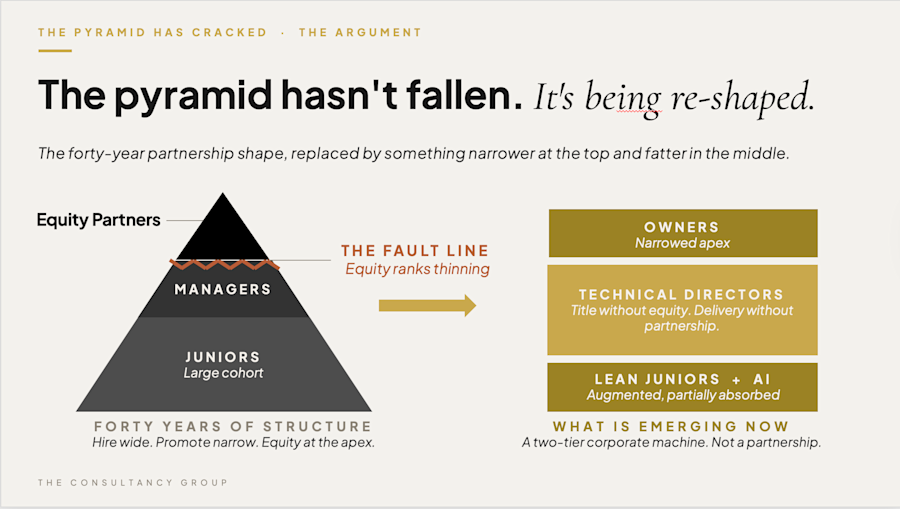
A larger layer of salaried Technical Directors. These are the demoted partners and elevated senior managers. They run delivery. They have title and authority but no equity stake. They are doing the work that used to win equity. The title remains. The economics do not.
This is the most uncomfortable part of the restructuring. The Technical Director carries the expectations of a partner: client ownership, delivery accountability, business development. The compensation structure is that of a senior employee. The title looks the same on a slide. Inside firms, the people in those seats are aware of this. They have not all said it out loud yet.
A leaner junior tier rounds out the model. Smaller cohorts, hired for technical fluency more than for traditional analytical capability. Increasingly augmented or partially replaced by AI tooling.
This is the two-tier corporate machine. It looks less like a partnership and more like a tech-enabled professional services company. That is not an accident. Many of the firms running this restructuring quietly admire how the platform businesses they advise have structured themselves.
The cultural fallout matters. The "collegiate partnership" is over. The loose social contract where you put in your decade, you make partner, you have a seat for life. What replaces it is transactional. If you are not generating revenue or masterfully wielding AI, your seat is at risk. That is true at salaried Technical Director level and increasingly true at equity Owner level too.
Who Is Winning Inside This
Two profiles are gaining ground.
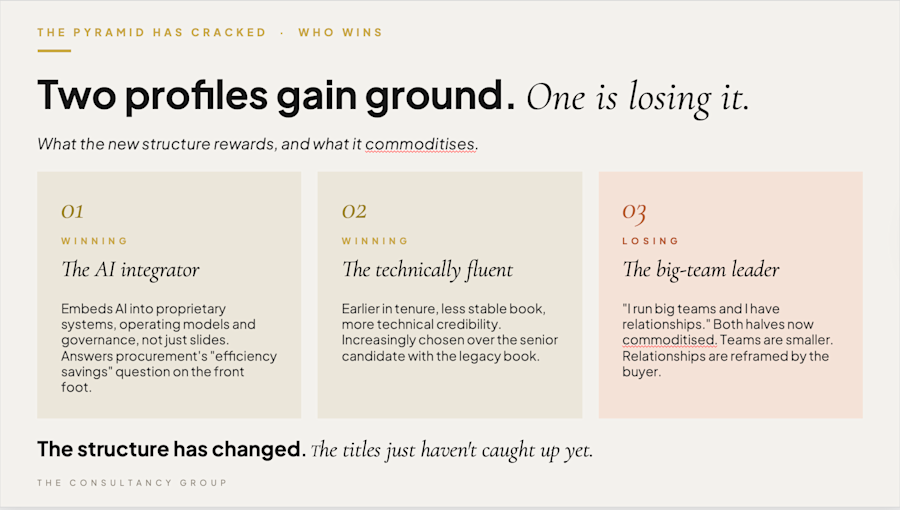
The first is the partner who can take AI beyond pilots and into integrated delivery. I see clients hiring around this profile specifically: someone who can embed AI into proprietary systems, operating models and governance frameworks, not just demonstrate it on a slide. That partner is commercially valuable because they can answer the "AI efficiency savings" question on the front foot rather than the back.
The second is the partner earlier in their tenure with genuine technical fluency. Less stable book, more technical credibility. In several recent pitches I have run, the firm hiring at director-to-partner level has explicitly chosen the more technically fluent candidate over the more senior one with a stable but legacy book. Five years ago that choice would not have been on the table.
What is losing ground is the partner whose value proposition is "I run big teams and I have relationships." Both halves of that proposition are being commoditised. The teams are getting smaller and the relationships, in many cases, are being reframed by the buyer.
The UK Is Where It Shows First
The pace of this restructuring varies across the EMEIA market, and the variation tells you something. The UK is moving fastest because it has the deepest PE buyer base challenging the consulting fee model and the strongest mid-market pipeline of partner-track exits.
That is not a coincidence: those are the two specific forces driving the structural change everywhere.
DACH is cautious but starting to unfreeze. The Nordics are pragmatic and deal-led. Southern Europe is quieter but improving off a low base. The Middle East continues to pull senior European talent out of the partnership track entirely, particularly in private equity and transformation.
What is consistent across all of them is the direction.
The pace varies. The destination does not.
The Real Question
The structure has changed. The titles just have not caught up yet.
Most partners working inside firms today know what is happening. They are watching the equity rolls thin and the AI revenue announcements multiply. They are running the maths in private. They have just not said it out loud.
The interesting question is not whether your firm will go through this. It is whether it has already started, and whether you know which side of the new structure you are on.
What are you seeing inside your firm?
If you are running a partnership through this restructuring, or thinking about your own position inside it, the conversations we are having with partners across MBB, Big 4 and boutique strategy firms cover exactly this territory. Get in touch.