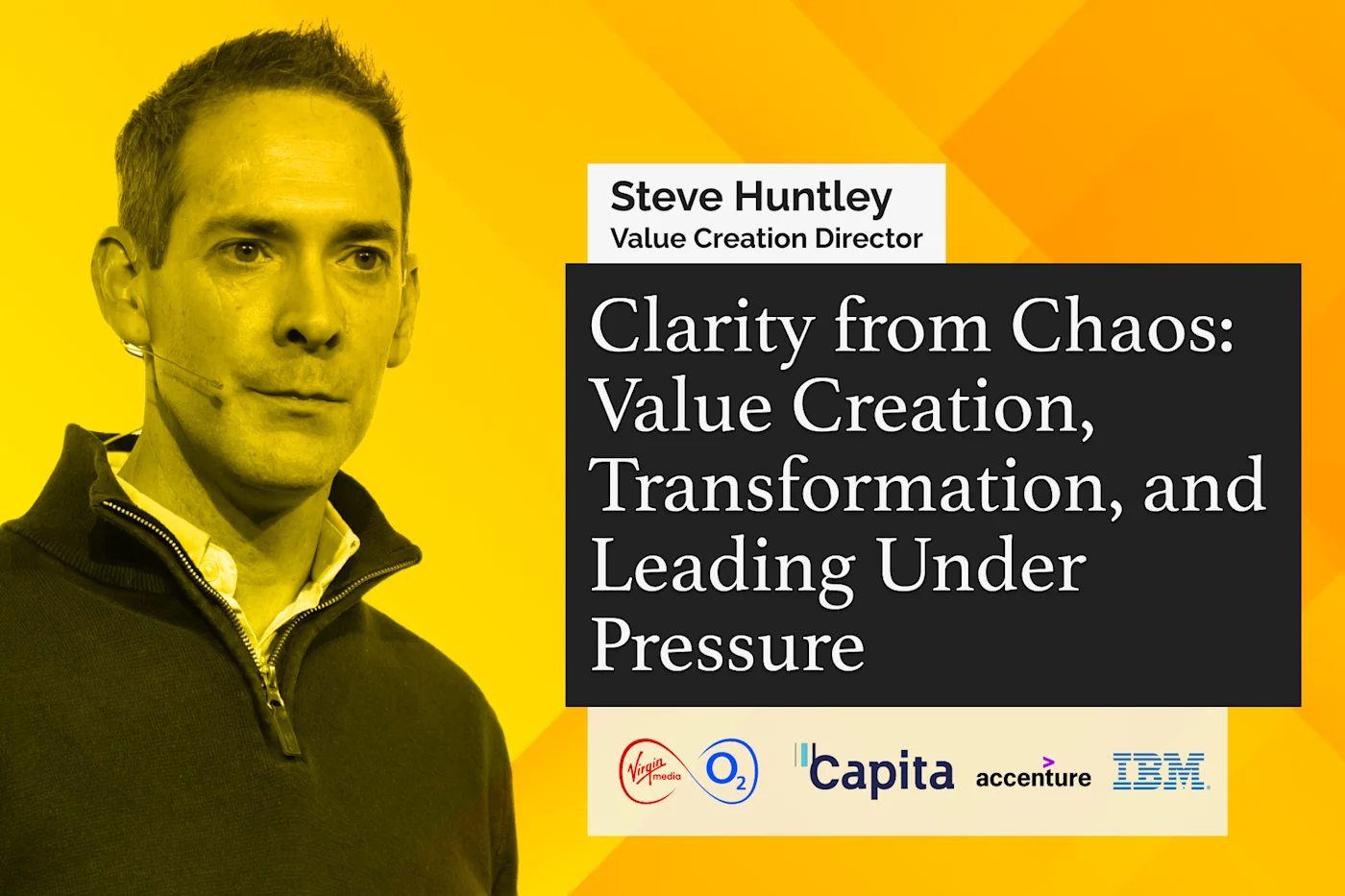
Steve’s career has spanned billion-pound transformations and brand-new consulting ventures. What ties it all together is his ability to navigate the messy middle. That’s the space where priorities compete, pressure builds, and strategy needs to turn into action.
What’s your go-to playbook for keeping strategy, execution, and outcomes aligned?
Regardless of size, I think the principles are the same: having the ability to bring clarity from chaos. No business is perfect; no stakeholder group is always utterly aligned; and value-creating transformation is rarely smooth. If it were easy, someone would have already executed it.
Having the ability and experience to envisage, architect and create a new path, whilst simultaneously adjusting and aligning, is the only playbook required in my view.
Where do most strategies fall down in execution, and what makes the difference between good intentions and real impact?
For me, there are three key reasons a strategy is more likely to fail:
When the process takes over.
When a transformational effort starts going through the motions and the organisation or team loses focus on what’s really important.
Businesses fail to adapt their strategy as they go.
Sustainable value often takes time to implement, and during that time things can change, internally or externally. Leadership teams who are able to pivot along the journey tend to get better results.
Failing to get going or make pragmatic changes.
I believe in the philosophy of failing fast. There is huge richness in trying something, learning from it and refining the next iteration. Far too often I’ve seen businesses let perfection get in the way of progress.
What do you look for when a business is stalled or underperforming?
I think it’s important to look beyond the balance sheet and trading reports.
Yes, data and trends will give you an indication of likely challenges and opportunities, but it’s just as important to understand things like customer sentiment, product roadmaps, investment choices (or missed opportunities), and workplace “pinch points” that prevent the business from becoming high-performing or implementing a specific priority.
You can often only uncover this by speaking to a few carefully chosen colleagues.
Value Creation: From Narrative to Numbers
We got talking about how the idea of value creation is changing, and why building credibility and momentum inside big, complex organisations is getting harder, not easier.
With more pressure to deliver results quickly, it’s not just about setting the right strategy. It’s about proving you can execute as well.
What does value creation actually look like in practice?
In my experience, value creation (VC) as a distinct function is relatively new.
Whilst it has existed in the private equity space for some time under various guises, corporates are only recently turning to a VC function that can both set and execute strategic priorities, whilst also adapting to market conditions.
Often value will be derived from multiple levers, and rarely do I see a corporate focusing on just one priority.
A good value creator will be able to curate a narrative between these levers and enable a positive spiral of success. For example:
Driving improved customer experience can increase revenue growth opportunities
Enhancing employee engagement can improve productivity
Increased productivity can improve margins
Margin improvement can fund further transformation
What strategic moves are you most proud of in the past year?
Having the customer at the heart of what you do is rarely a bad idea.
Last year at VMO2 Business, we really doubled down on how we could improve our relationships with our B2B customers. This was both data-led and experience-led, and it changed the way we made decisions in our business.
During a period of uncertainty, we were proud of delighting our customers and finding ways to make them buy more from us when times get better.
How do you lead with data in complex environments?
I have a saying that “sunshine is the best disinfectant.”
What I mean by that is using data to shine a light on all the things that aren’t going well.
As someone who thrives on strategising and transforming in challenged or high-growth situations, data should always be an important input into how you lead and take decisions.
Having led data functions during my career, most recently at VMO2 Business, you’re unlikely to rely on data alone. But if nothing else, it will highlight areas worth probing.
The real question to ask your data team is:
“What doesn’t the data tell us, and why?”
Transformation in Action
We moved on to talk about transformation on the ground.
Steve has been in the thick of billion-pound technology programmes and day-one delivery challenges, so I was curious: what actually separates transformations that land from the ones that never quite get there?
What separates the transformations that succeed from the ones that don’t?
Consistency in the team and the leadership is often a major differentiator.
Handoffs between different sponsors and across a multitude of suppliers or internal functions is often where mistakes are made, estimates exaggerated, accountability lost and focus diminished.
If you’re not set up to be accountable for both architecting the strategy and delivering the outcomes, then transformational change becomes much more difficult and requires even greater stakeholder alignment.
How do you balance tech ambition with real-world constraints?
It can be misleading to assume that all innovation or technology is costly and messy. Being too risk-averse when it comes to innovation is a transformation killer.
What’s often more pragmatic is asking:
“What’s the minimum we could get away with?”
That’s not about settling for low quality. It’s about understanding what is absolutely essential.
In my experience, this creates a benchmark that teams can build from. Smaller, less risky steps lead to faster results, which encourages teams to innovate further.
Teams feel more productive, learn from both wins and losses, and are more willing to iterate.
What’s your approach when urgency, complexity and expectations collide?
Don’t rush in.
Take a small amount of time to define what success looks like and understand what is truly non-negotiable. The faster you align this with stakeholders, the better.
Then:
Focus only on what moves the needle
Involve only high-impact contributors and empower them to move fast
Set the rhythm and heartbeat, especially around communication
Finally, a business needs a calm leader under pressure.
Teams mirror the energy of the leader. In intense situations, staying cool and collected makes all the difference.
Personal Lessons in Leadership
You can’t speak to someone who has led as much change as Steve has without discussing the people side of transformation.
Transformation is never just about technology. It’s the humans involved that make or break large-scale programmes.
And for all the results he has delivered, what stands out most is how grounded he remains about the messy reality of leading through it.
What did you learn from building a consulting business inside a FTSE-listed company?
It taught me that forming a consulting business is hard.
Despite the expertise, willingness and track record of the team, it still wasn’t straightforward to build momentum.
We learned to celebrate every win, regardless of size. We became incredibly resourceful. A small team meant everyone pitching in and finding creative ways to make progress.
To build scale, credibility and pace, we partnered strategically and developed relationships with peers. We also found win-win opportunities with competitors in the segment.
How do you sharpen your thinking?
I always try to travel for work by train rather than alternatives, even if it’s slightly less convenient.
The dedicated time and headspace really works for me. It gives me bandwidth to read, reflect and prioritise, while ensuring that thinking time doesn’t eat into family time at home.
It means I arrive sharper at work and more relaxed at home.
What’s a lesson from your voluntary work that’s shaped your leadership?
I’ve been fortunate to use my professional experience to support some great causes.
The biggest lesson has been to always show up authentically.
Everyone wants to work for an authentic leader. Especially in unfamiliar or difficult situations, authenticity motivates people, builds engagement and improves performance.
In my experience, it can make the difference between a short-lived result and a sustainable one.
Final Word
As the conversation drew to a close, I asked Steve two final questions: one looking ahead and one looking back.
Where is value creation heading next? And what advice would he give someone stepping into their first senior strategy role?
Where do you think the next frontier of value creation will come from?
As industries, business models and workplace patterns continue to shift, I think value will increasingly come from leadership teams’ ability to adapt quickly, effectively and purposefully.
We don’t know where the next technological breakthrough or market shock will come from. But the ability to repeatedly turn uncertainty into value will be an increasingly valuable capability.
And if someone’s just stepping into their first senior strategy role?
Be intellectually curious and always have an opinion.
Strategy is about facing the unknown, taking calculated risks and shaping a new journey.
That becomes much easier and more impactful when you truly understand the business you’re working in.
And you can’t do that without having an opinion.
Right or wrong, having an opinion encourages debate and new ways of thinking. That behaviour should start at the top and be encouraged across teams.
Closing Thought
From startup ventures to billion-pound integrations, Steve’s experience makes one thing clear.
Successful transformation isn’t about rigidly sticking to the plan. It’s about knowing when and how to flex.
Whether he’s talking about strategy, leadership or execution, the message is consistent: stay grounded, stay human, and stay focused on what really moves the needle.