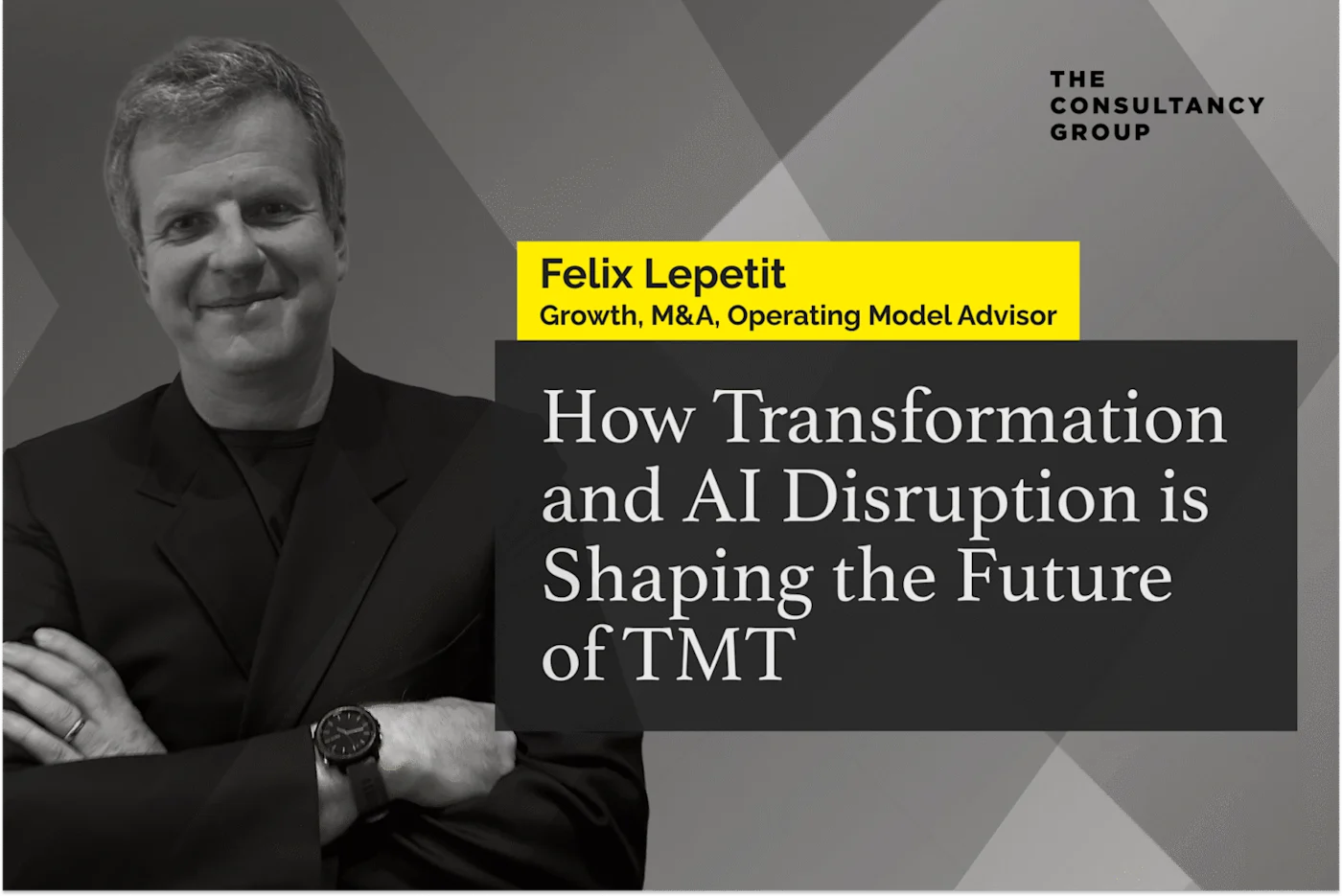
With a career spanning over 20 years, 15 of which at Deloitte, and a focus on TMT strategy and transformation, Felix Lepetit has worked with established and digital native media organisations, global and niche tech companies, and both incumbent and challenger telecoms players to navigate uncertainties and seize opportunities in this rapidly evolving sector.
In our conversation, Felix explored the complexities of long-established organisations striving to overcome legacy, the opportunities created by AI, and the importance of aligning business transformation with strategic goals.
A Career Rooted in Transformation
Felix’s journey into TMT was far from linear.
Starting in engineering, with a postgraduate degree in aerospace and a PhD thesis on aircraft engine components, he initially worked in consulting on commercial diligence for private equity and corporate strategy across a range of industry sectors.
But it was the dynamism of TMT that ultimately drew him in.
“Traditional engineering moves at a snail’s pace compared to TMT,” Felix reflects. “What excites me about TMT is the constant evolution. It’s a broad church encompassing everything from leading software platforms to legacy and challenger media businesses, telecoms operators large and small.”
Over the years, Felix has specialised in what he describes as the “strategy meets transformation nexus” for content organisations in particular.
His work spans consumer media, news, B2B publishing, education, broadcasting, audio, content production and more, helping organisations adapt to changing market dynamics, shifting consumer behaviours and emerging technologies.
Audience Fragmentation and the Proliferation of Channels: A Burning Platform
The challenges facing long-established media organisations often stem from the proliferation of content and delivery channels, alongside the disruptive impact of digital platforms.
Felix describes the environment as one where traditional players must balance meeting the shifting demands of end users or audiences, overcoming the complexities of legacy systems, and retaining their heritage strengths.
“Legacy media businesses typically struggle with complex organisations, slowness to respond to market dynamics, fragmented systems hindering visibility of true financial and audience performance, and the difficulty of creating content that can be delivered and monetised across multiple channels,” he explains.
“At the same time, consumers have access to an abundance of choice, including free, freemium or low-cost alternatives.”
For these organisations, the rise of digital disruptors, now established global players in their own right such as Spotify, Netflix and social media platforms, has amplified the need for transformation.
“The burning platform is clear, either adapt or be left behind,” Felix warns.
AI and Gen AI: From Hype to Practicality
Generative AI (Gen AI) is undeniably a game-changer, but Felix cautions against viewing it as a panacea.
“AI has been part of TMT for years, helping organisations automate or speed up processes and free up resources for higher-value tasks. But with Gen AI, we’re seeing new opportunities for creativity and efficiency.”
He points to practical applications such as content repurposing, where AI helps organisations identify, categorise and transform existing assets into new formats.
“Gen AI can help generate derivative content like social media posts or promotional videos at scale, or prompt new story ideas based on the content archive, saving time and effort,” Felix notes.
However, he stresses the importance of human oversight.
“AI is a tool, not a replacement. Human curation and clear guidelines remain critical to ensure quality and relevance.”
Felix also highlights AI’s potential to address financial transparency challenges.
“Many organisations struggle to link content creation costs with ROI. AI can help by providing insights into the financial and audience performance of content, enabling more informed decision-making.”
The Role of Big Tech: Pioneers or Gatekeepers?
As platforms like Amazon, Facebook and Netflix continue to dominate, Felix acknowledges their dual role as both enablers and disruptors.
“These companies wield enormous power over how content is distributed and monetised,” Felix says.
“For legacy media players, such platforms can represent any combination of channel, customer, technology partner or competitor, which continues to raise questions around fair recognition of IP and attribution of value.”
At the same time, these platforms have now been around for 15–20 years and face their own challengers from the new wave of disruptors.
“At what point does a digital native big tech platform transition to having legacy characteristics?”
“In an environment where AI and Gen-AI increasingly feature, both overtly and behind the scenes, how these global players should support transparency, traceability and due governance is the latest chapter in the debate on big tech’s role.”
Business Transformation Over Technology Transformation
For Felix, successful transformation must start with the business, not the technology.
“The risk of letting technology drive strategy is that it often leads to rejection by the business,” he warns.
Instead, he advocates aligning transformation efforts with clear business objectives and involving employees in identifying the organisational and operational changes required to deliver those objectives.
“People need to see how changes benefit them and contribute to the organisation’s goals.”
This collaborative approach, he argues, ensures solutions are grounded in organisational reality while also securing cultural buy-in and long-term success.
The Future of TMT: Endless Opportunities
Looking ahead, Felix is optimistic about the potential of TMT to drive innovation and create value.
“The implications of AI and automation are vast. We’ve only scratched the surface of what’s possible,” he says.
He compares the current moment to past technological evolutions, from the launch of mobile and web 1.0 to the rise of social media, smartphones and global streaming platforms.
“With every major shift, there are winners and losers, and the winners are not necessarily the initial frontrunners. The organisations that succeed will be those that adapt quickly and align their strategies with emerging demands, harnessing new technologies to build on their strengths.”
Final Thoughts
Felix’s career in TMT has given him a unique vantage point on the intersection of strategy, transformation and technology.
His insights underscore the importance of aligning business objectives with technological advancement while maintaining a human-centred approach.
“TMT is a never-ending feast,” he concludes. “The challenge, and the opportunity, is to navigate this complexity with vision, a focus on how to create value for the end user, and adaptability.”
As the sector continues to evolve, Felix’s perspective offers a compelling blueprint for how organisations can thrive in a world defined by constant change.